
Election Commission of India for UPSC: Powers, Functions and Electoral Reforms
The Election Commission of India for UPSC is an important topic under Indian Polity because elections are central to democracy, political representation and constitutional governance. Aspirants should understand not only the Commission’s structure but also its constitutional powers, responsibilities and challenges.
For students building their foundation in Indian Polity, systematic revision and current-affairs analysis can help connect constitutional provisions with real-world developments. Aspirants seeking structured guidance can also explore IAS Coaching in Hyderabad at Ignite IAS.
What is the Election Commission of India?
The Election Commission of India (ECI) is a constitutional body responsible for administering elections to Parliament, State Legislatures, and the offices of the President and Vice-President of India. Its primary purpose is to help ensure that elections are conducted in accordance with the Constitution and applicable election laws.
Article 324 and the constitutional basis
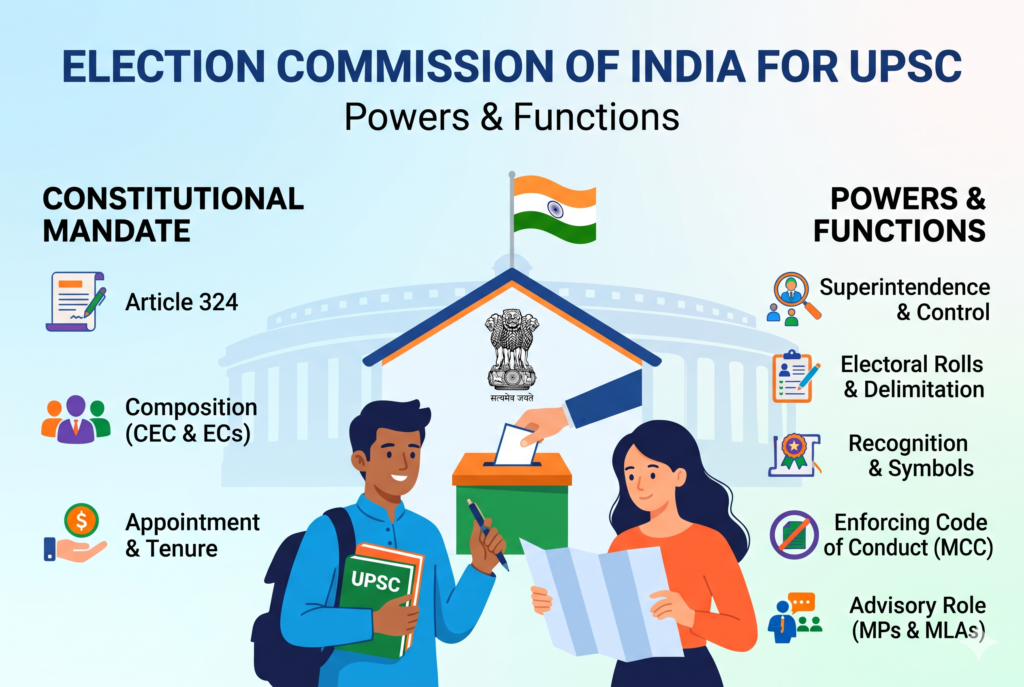
Article 324 for UPSC is especially important because it provides for the superintendence, direction and control of elections to Parliament, State Legislatures, and the offices of the President and Vice-President to be vested in the Election Commission.
The Commission operates alongside other constitutional provisions and election laws. For example, the Representation of the People Acts provide important legal rules governing elections and electoral processes.
Read the official Election Commission of India information for authoritative details. Election Commission of India+1
What are the main Election Commission powers?
The Election Commission powers include several responsibilities that help manage the electoral process.
1. Electoral roll management
The Commission oversees electoral-roll preparation and revision through the established election administration system. Accurate voter lists are essential for eligible citizens to participate in elections.
2. Election scheduling and administration
It supervises the conduct of elections, including election schedules, polling arrangements, counting and the declaration of results, within its constitutional and statutory responsibilities.
3. Model Code of Conduct
The Model Code of Conduct provides norms for political parties and candidates during elections. The ECI works to ensure compliance with the code and prevent misuse of official machinery for electoral advantage. Election Commission of India
4. Political parties and election symbols
The Commission performs functions relating to political-party registration under applicable law and the allotment and recognition of election symbols under the relevant rules.
Electoral reforms in India: Challenges and opportunities
Electoral reforms in India aim to strengthen transparency, participation and public confidence. Issues often discussed include election expenditure, criminalisation of politics, misinformation, voter awareness, campaign finance and the use of technology in elections.
For UPSC Mains, avoid simply listing problems. Explain how each issue affects free and fair elections, then discuss feasible reforms, institutional accountability and citizen participation.
Why is this topic important for UPSC?
The Election Commission of India for UPSC connects with the Constitution, governance, political processes and current affairs.
- Prelims: Article 324, constitutional bodies, election laws and institutional functions.
- Mains: Electoral reforms, independence of institutions, democratic accountability and challenges to free and fair elections.
- Interview: The importance of impartial election administration and informed citizenship.
Students looking for a structured study plan can review the Ignite IAS website for information about its IAS preparation programmes.
Frequently Asked Questions
1. Which Article of the Constitution deals with the Election Commission?
Article 324 provides for the Election Commission’s superintendence, direction and control of specified elections.
2. What is the main function of the Election Commission of India?
Its principal responsibility is to administer elections to Parliament, State Legislatures, and the offices of the President and Vice-President.
3. What is the Model Code of Conduct?
It is a set of norms for political parties and candidates intended to support fair electoral conduct.
4. Why is the Election Commission important for UPSC?
It is relevant to Indian Polity, constitutional bodies, governance, democracy and electoral reforms.
5. How should aspirants study electoral reforms?
Understand the constitutional framework, identify key challenges, examine reform proposals and connect the topic to current affairs.