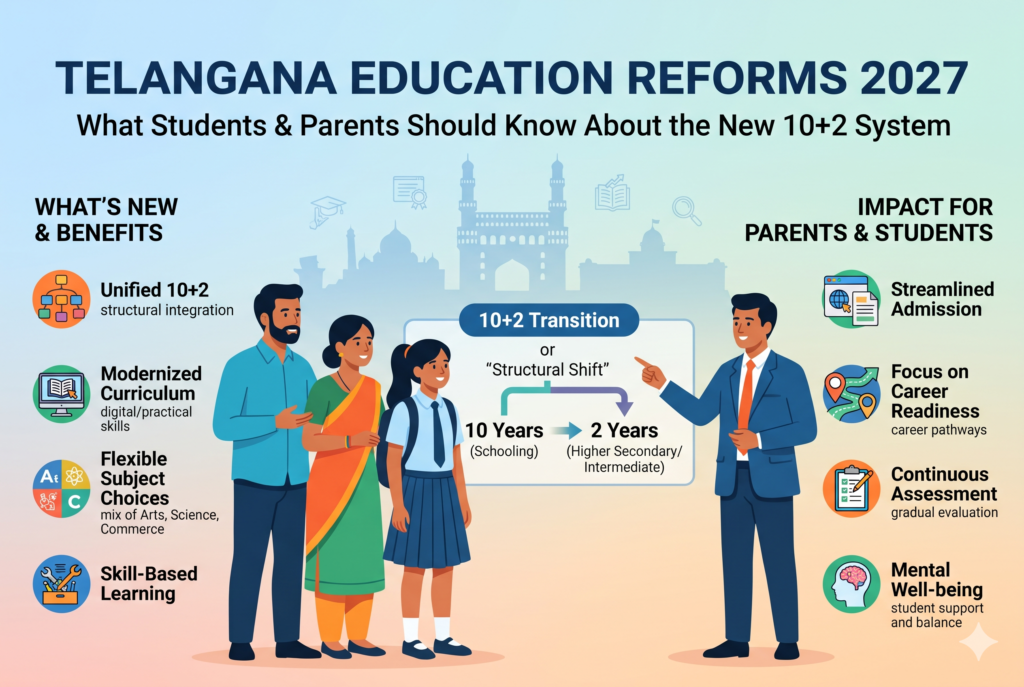
Is Telangana Preparing for a Major Change in Its Education System?
For generations, students in Telangana have followed a familiar academic journey: complete Class 10, join a junior college, choose MPC, BiPC, MEC or CEC, and then prepare for university admissions or competitive examinations.
But what if this familiar system changes?
In November 2026, the Telangana government announced plans to restructure school education by bringing Classes 11 and 12 into a broader school education framework. This proposal could change how students experience the transition from Class 10 to intermediate-level education.
The proposed Telangana Education Reforms 2027 have raised several important questions among students, parents, teachers and educational institutions.
Will junior colleges continue in their existing form? Will MPC, BiPC, MEC and CEC remain available? What happens to students already studying Intermediate? Will competitive examination preparation be affected?
These are not questions that students should answer through social media rumours.
Understanding the government’s announcement, the reasons behind it, the concerns being discussed and the legal rights of students is important before making any academic decision.
Let’s understand what is happening and what students should prepare for.
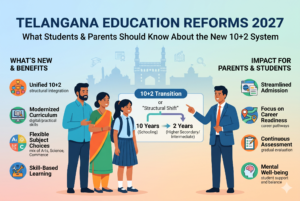
1. What Happened? Understanding Telangana’s New 10+2 Education System
On November 11, 2026, Telangana Chief Minister A. Revanth Reddy reviewed the Education Department’s plans and directed officials to prepare for a revised education structure from the next academic year.
The proposed structure divides education into three stages:
| Education stage | Proposed classes |
|---|---|
| Primary Education | Nursery to Class 4 |
| Secondary Education | Classes 5 to 8 |
| Senior Secondary Education | Classes 9 to 12 |
The most significant proposal is the integration of Classes 11 and 12 into the school education framework.
Currently, students generally complete Class 10 in school and move to separate junior colleges for their Intermediate education.
Under the proposed system, students would continue their education through Classes 11 and 12 within a more integrated structure.
The government’s stated objectives include improving educational continuity, reducing student dropouts, strengthening language and communication skills, and preparing students for future academic and professional opportunities.
However, the detailed administrative arrangements and implementation framework are still being discussed.
2. Why Is the Government Considering This Education Reform?
One of the major concerns highlighted by the government is the number of students who discontinue their education after Class 10.
According to the Chief Minister’s November announcement, around 40% of students were reportedly dropping out after Class 10, with particular concerns involving girls and students from Dalit, tribal and minority communities.
The government pointed to institutions such as Kendriya Vidyalayas, Jawahar Navodaya Vidyalayas and Kasturba Gandhi Balika Vidyalayas, where students have access to education up to Class 12.
The proposed reform aims to encourage students to continue their education without facing a major institutional transition after Class 10.
Reducing the gap between school and Intermediate education
Moving from Class 10 to a separate junior college can involve changes in location, travel, fees, academic environment and admission procedures.
For students from rural and economically weaker backgrounds, these challenges can sometimes become barriers to continuing education.
An integrated structure could help reduce some of these difficulties if adequate schools, teachers and infrastructure are available.
Improving communication and language skills
The government has also emphasised language proficiency and communication skills.
Students need more than textbook knowledge to succeed in higher education and employment. Communication, critical thinking, digital awareness and analytical ability are increasingly important.
Preparing students for future careers
Education should prepare students for different opportunities, including engineering, medicine, commerce, management, law, civil services, vocational education and emerging technology fields.
The challenge will be ensuring that students receive both strong foundational education and suitable subject choices.
3. What Could Change for MPC, BiPC, MEC and CEC Students?
This is probably the biggest question for students currently planning their Intermediate education.
For many years, students in Telangana have selected streams such as:
- MPC – Mathematics, Physics and Chemistry
- BiPC – Biology, Physics and Chemistry
- MEC – Mathematics, Economics and Commerce
- CEC – Civics, Economics and Commerce
- HEC – History, Economics and Civics
These combinations help students build the academic foundation required for different higher education pathways.
For example:
| Student interest | Common academic pathway |
|---|---|
| Engineering | MPC |
| Medicine and life sciences | BiPC |
| Commerce and management | MEC or relevant alternatives |
| Law and civil services foundation | Relevant combinations depending on institutional offerings |
| Humanities and social sciences | Relevant humanities combinations |
An important point is that the proposed restructuring does not automatically mean these subjects will disappear.
The government will need to explain how subject combinations, specialised teaching, laboratories, faculty and academic administration will work under the new framework.
Students should therefore avoid making admission decisions based on unverified claims about the discontinuation of any particular stream.
4. What Happens to Students Already Studying Intermediate?
This is where students and parents need to pay close attention.
On November 25, 2026, the Telangana Board of Intermediate Education clarified that consultations were continuing with stakeholders and that there would be no immediate change to the syllabus, examination pattern or teaching methodology for students currently pursuing Intermediate.
The clarification also addressed students joining Class XI in the next academic year, stating that there would be no immediate academic changes for them.
This is important because students preparing for board examinations need clarity rather than uncertainty.
What should current Intermediate students do?
- Continue preparing according to the officially announced syllabus.
- Follow examination notifications from the relevant education board.
- Do not change colleges or subjects based on rumours.
- Confirm any admission-related changes directly with recognised institutions.
- Follow official notifications regarding future academic arrangements.
Students should remember that a proposed administrative restructuring does not automatically change their immediate academic responsibilities.
5. What Are the Main Concerns and Questions About This Reform?
Every major education reform needs careful planning. A policy may have positive objectives, but its success depends on how it is implemented.
Here are some important questions students, parents and educators should ask.
Will every school have the infrastructure to offer Classes 11 and 12?
Senior secondary education requires more than ordinary classrooms.
Schools may need science laboratories, qualified subject teachers, libraries, suitable equipment and additional academic facilities.
The government will need to explain how these requirements will be addressed, especially in rural and government schools.
What happens to existing junior colleges?
Telangana has a large number of junior colleges with established infrastructure, lecturers and academic systems.
The future role of these institutions, their staff and their facilities needs clear communication.
How will competitive examination preparation be affected?
Many students prepare for JEE, NEET, EAPCET, CLAT and other entrance examinations alongside Intermediate studies.
The proposed structure should ensure that students retain access to suitable subject teaching, practical sessions, examination preparation and academic guidance.
Will private schools and colleges be able to implement the changes?
Private institutions may need additional laboratories, classrooms, qualified teachers and regulatory approvals to offer senior secondary education.
The government will need to clarify the standards and approval process applicable to different institutions.
These are legitimate policy questions. They should be discussed using official information and stakeholder feedback rather than assumptions.
6. What Laws and Education Rights Should Students Know?
Students and parents should understand that education is not simply an administrative service. It is also supported by constitutional provisions and legal frameworks.
Article 21A – Right to Education
Article 21A of the Indian Constitution provides for free and compulsory education for children between 6 and 14 years of age.
The Right of Children to Free and Compulsory Education Act, 2009 provides the legal framework for this right.
Students and parents should understand that this specific constitutional guarantee covers the 6–14 age group. It should not be confused with a general guarantee of free education at every higher education level.
Right to Information Act, 2005
The RTI Act gives Indian citizens a mechanism to request information held by public authorities, subject to the exemptions and procedures in the Act.
Students and parents can use it to seek existing records about public education decisions, such as:
- Copies of government orders concerning education reforms.
- Published policy documents and implementation guidelines.
- Information about approved school infrastructure projects.
- Publicly available details of allocated funds and expenditure.
- Relevant inspection or monitoring reports, where disclosable.
For example, if parents want to understand the proposed implementation of the new education structure, they can look for official orders and published guidelines. Where information is not publicly available, they may consider a specific RTI request to the appropriate public authority.
National Education Policy 2020
The National Education Policy 2020 discusses changes to the structure and quality of school education, foundational learning, multidisciplinary education and skill development.
It provides an important national policy context for understanding education reforms.
However, students should distinguish national policy recommendations from specific Telangana government implementation orders.
Protection of student interests
Students and parents should also understand the applicable rules concerning school recognition, examination procedures, child protection, non-discrimination and grievance mechanisms.
If a school or college communicates a major change in fees, admission conditions, course availability or examination arrangements, families should request the relevant written notification and seek clarification from the competent authority.
7. What Should Students and Parents Prepare For?
The best response to an education reform is preparation, not panic.
For Class 10 students
- Understand the available academic streams and their career pathways.
- Follow official admission announcements.
- Compare institutions based on subject availability and teaching quality.
- Ask whether the institution has the required laboratories and faculty.
- Do not select a stream only because of social pressure.
For Class 11 and 12 students
- Continue following your current academic syllabus.
- Prioritise board examination preparation.
- Track official examination and admission notifications.
- Maintain a separate preparation plan for entrance examinations if required.
- Avoid making sudden decisions based on unverified online information.
For parents
- Attend official school or college meetings.
- Ask for written clarification about proposed academic changes.
- Check the institution’s recognition and facilities.
- Understand the financial implications of any change.
- Follow notifications from the relevant education authorities.
For students planning civil services preparation
Early academic awareness can help students develop reading habits, communication skills, general knowledge and analytical thinking.
Students interested in civil services can explore structured foundation learning alongside their regular education.
Explore the Ignite IAS admissions page for information about available academic and preparation pathways.
8. How Can Students Verify Government Education Announcements?
In the age of social media, a single headline can create confusion among thousands of students.
A responsible student should learn to verify information before sharing or acting on it.
Use these official resources:
- Telangana Government Portal: https://www.telangana.gov.in/ – Government announcements and official press releases.
- Telangana Education Commission: https://tec.telangana.gov.in/ – Education policy reports and recommendations.
- Telangana Board of Intermediate Education: https://tgbie.cgg.gov.in/ – Intermediate-related notifications and updates.
- Board of Secondary Education Telangana: https://www.bse.telangana.gov.in/ – SSC examination-related information.
- Ministry of Education: https://www.education.gov.in/ – National education policies and announcements.
Before accepting any major education-related claim, check:
- Is there an official government order?
- Has the relevant education board issued a notification?
- Is the information a proposal, announcement or implemented decision?
- Does the change apply to current students or only future admissions?
- Has the institution provided written clarification?
This approach helps students distinguish facts from speculation.
Conclusion: Education Reforms Should Create Opportunities, Not Confusion
The proposed Telangana Education Reforms 2027 could become an important development in the state’s education system.
The intention to reduce student dropouts, improve academic continuity and strengthen communication and learning skills is significant.
However, the success of the reform will depend on clear implementation guidelines, adequate infrastructure, qualified teachers, suitable subject choices and transparent communication with students and parents.
For students, the most important lesson is to stay informed, understand their rights and prepare for future opportunities without being influenced by rumours.
Education is not just about completing examinations. It is about developing the knowledge, confidence and skills required to make informed decisions throughout life.
At Ignite IAS, we believe that students should understand not only their textbooks but also the policies, laws and developments shaping their future.
Stay informed. Ask questions. Understand your rights. Prepare for your future.
Frequently Asked Questions (FAQs)
1. What are the Telangana Education Reforms 2027?
The Telangana government has announced plans to restructure school education into a Nursery-to-Class-12 framework, with Classes 11 and 12 brought into the broader school education system. Detailed implementation arrangements are still under discussion.
2. Will Telangana remove the Intermediate education system?
The government is considering integrating Intermediate education into the school education framework. The final administrative structure and detailed modalities are yet to be clarified.
3. When will the new 10+2 education system begin in Telangana?
The government has directed officials to prepare for the proposed structure from the next academic year, expected to be 2027–28. Students should follow official implementation notifications for confirmation.
4. Will MPC, BiPC, MEC and CEC streams be discontinued?
There is no confirmed announcement that these subject combinations will be discontinued. Students should wait for official details about subject availability under the revised structure.
5. Will the new education reforms affect current Intermediate students?
As clarified by the Telangana Board of Intermediate Education on November 25, 2026, there will be no immediate change to the syllabus, examination pattern or teaching methodology for students currently pursuing Intermediate.
6. Why is Telangana planning to integrate Classes 11 and 12 into schools?
The stated objectives include reducing dropouts after Class 10, improving educational continuity, strengthening communication skills and making senior secondary education more accessible.
7. What should Class 10 students do before choosing Intermediate subjects?
Students should understand their career interests, compare subject combinations, check institutional facilities and follow official admission guidelines before selecting a stream.
8. Can students use RTI to understand education reforms?
Yes. Indian citizens can request existing information and records from public authorities under the RTI Act, 2005, subject to its procedures and exemptions.
9. Will competitive examinations such as JEE and NEET be affected?
No specific change to these entrance examinations follows automatically from the state education announcement. Students should continue following the official examination authorities for eligibility, syllabus and examination notifications.
10. Where can students find official Telangana education updates?
Students can follow the Telangana Government Portal, Telangana Board of Intermediate Education, Board of Secondary Education Telangana and Telangana Education Commission websites.