
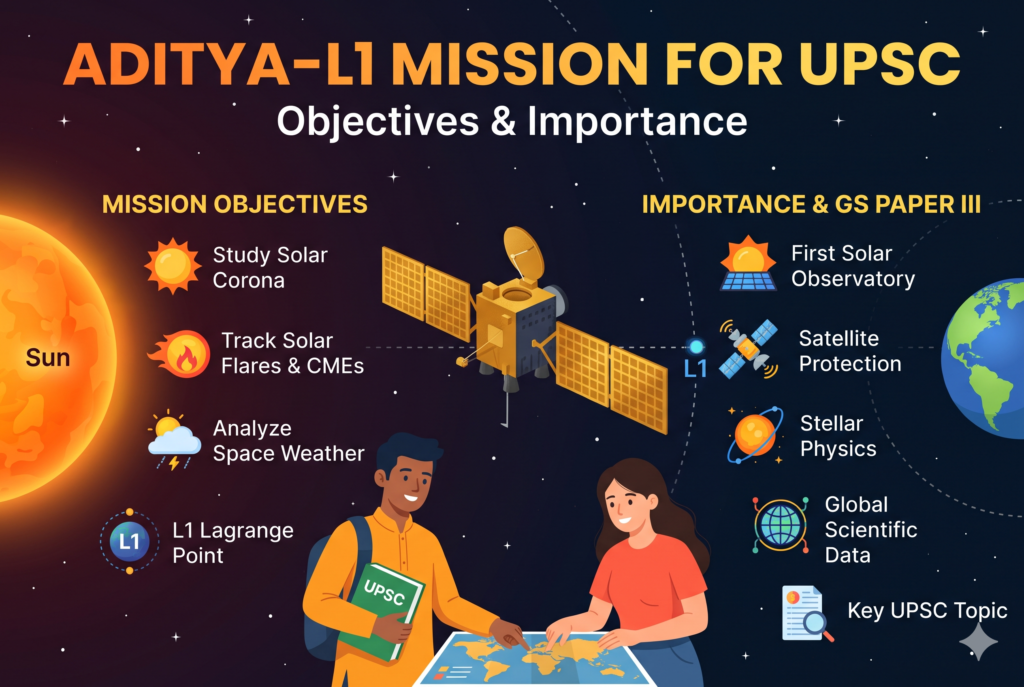
The Aditya-L1 mission for UPSC is an important topic in Science and Technology because it demonstrates India’s capabilities in space-based solar observation. Understanding the mission helps aspirants connect space research with scientific development, space weather and the practical applications of astronomy.
India’s solar mission is designed to study the Sun from space. For examination preparation, aspirants should focus on its location, scientific objectives, instruments and relevance rather than memorising isolated facts.
What is the Aditya-L1 mission?
Aditya-L1 is India’s first space-based observatory-class mission dedicated to studying the Sun. The spacecraft operates in a halo orbit around the Sun–Earth Lagrange Point 1 (L1), approximately 1.5 million kilometres from Earth.
This location offers a major advantage: the spacecraft can observe the Sun continuously without the regular interruptions caused by Earth eclipsing or occulting it. ISRO+1
What are the main Aditya-L1 objectives?
The Aditya-L1 objectives focus on understanding the Sun’s outer atmosphere, solar activity and the processes that influence space weather.
1. Studying the solar corona
The corona is the Sun’s outer atmosphere. Scientists investigate why it is much hotter than the layers below it and how energy is transferred through the solar atmosphere.
2. Understanding solar flares and coronal mass ejections
Solar flares are sudden releases of energy, while coronal mass ejections (CMEs) involve large quantities of plasma and magnetic field being expelled from the Sun.
Studying these events can improve scientific understanding of solar activity and its possible effects on near-Earth space.
3. Investigating solar wind
The solar wind is a continuous flow of charged particles from the Sun. Studying its properties helps researchers understand how solar activity interacts with the space environment.
4. Understanding space weather
Space weather can affect satellites, radio communication, navigation systems and other space-based infrastructure. Research from Aditya-L1 contributes to a better understanding of the solar processes behind these effects.
Why is the L1 point important?
The L1 point is a location in the Sun–Earth system where gravitational and orbital effects allow a spacecraft to maintain a useful position relative to both bodies with appropriate orbital management.
For ISRO missions for UPSC, remember that Aditya-L1 is not a mission to land on the Sun. It observes solar phenomena remotely and measures particles and fields in its surrounding space environment.
What instruments does Aditya-L1 carry?
The spacecraft carries seven scientific payloads designed to observe the solar photosphere, chromosphere and corona, along with particles and magnetic fields. Some instruments observe the Sun remotely, while others perform in-situ measurements near L1. ISRO+1
This distinction is useful for Prelims questions that test the mission’s purpose and scientific design.
How should UPSC aspirants prepare this topic?
For Aditya-L1 mission for UPSC, prepare the following:
- Mission objective and launch organisation.
- Location and advantages of L1.
- Major scientific objectives and payload functions.
- Solar flares, CMEs, solar wind and space weather.
- Applications of space research in communication, navigation and satellite protection.
For further preparation, students can explore the Direct IAS and other preparation options at Ignite IAS. The admissions page provides information about its programmes and counselling.
Frequently Asked Questions
1. What is the main purpose of Aditya-L1?
Its main purpose is to study the Sun and improve scientific understanding of solar processes and space weather.
2. Where is Aditya-L1 located?
It operates in a halo orbit around the Sun–Earth L1 point, about 1.5 million kilometres from Earth.
3. How many payloads does Aditya-L1 carry?
It carries seven scientific payloads.
4. Why is Aditya-L1 important for India?
It strengthens India’s capacity for solar research and contributes to knowledge about phenomena that can affect space-based infrastructure.
5. Which UPSC subjects cover Aditya-L1?
It is relevant to Science and Technology, space research and current affairs.