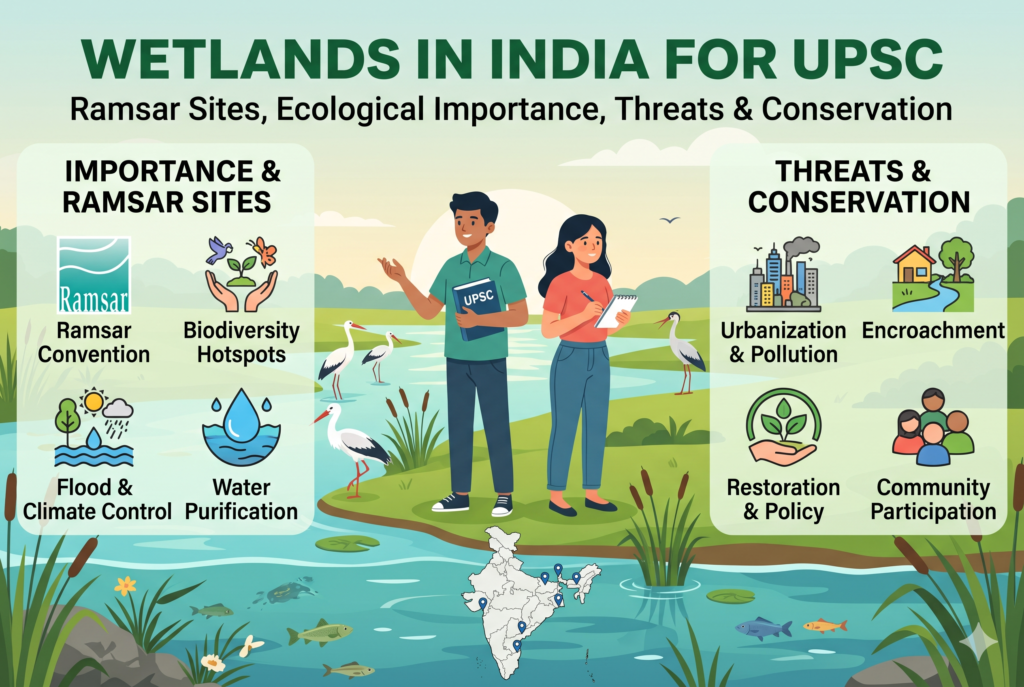
Wetlands in India for UPSC: Ramsar Sites, Ecological Importance, Threats and Conservation
Wetlands in India for UPSC is an important topic under Environment and Ecology, especially for students preparing for UPSC Prelims and General Studies Paper III.
Wetlands support biodiversity, regulate water flows, provide habitat for migratory birds and contribute to local livelihoods.
They also connect with climate change, water management, environmental governance and international conservation agreements.
Understanding their ecological importance, threats and conservation strategies helps aspirants develop a comprehensive approach to environment-related questions.
What are wetlands?
Wetlands are ecosystems where water influences the soil, vegetation and ecological processes, either permanently or seasonally.
Examples include marshes, swamps, floodplains, mangroves, shallow lakes and other water-dependent environments.
Wetlands may contain freshwater, brackish water or saline water.
Their ecological characteristics depend on factors such as water depth, seasonal variation, vegetation and surrounding land use.
Major types of wetlands in India
1. Inland wetlands
Inland wetlands include lakes, marshes, floodplains, river-associated wetlands and certain reservoirs.
They provide habitat for aquatic organisms and can help regulate local water systems.
2. Coastal wetlands
Coastal wetlands include mangroves, estuaries, coastal lagoons and tidal marshes.
They provide important habitats for marine and coastal species and can help reduce certain coastal hazards.
3. Natural wetlands
Natural wetlands form through ecological and geological processes.
Their water availability may change seasonally, and their ecosystems can be sensitive to changes in rainfall, river flow and land use.
4. Human-made wetlands
Certain reservoirs, tanks and managed water bodies can function as wetlands.
Some support biodiversity and local livelihoods, although their ecological characteristics may differ from natural wetlands.
What is the ecological importance of wetlands?
Biodiversity conservation
Wetlands support fish, amphibians, reptiles, birds, mammals and a wide range of plant species.
They provide feeding, breeding and resting habitats, including for migratory birds travelling across international flyways.
This makes biodiversity conservation in India closely connected with the protection of wetlands.
Flood regulation
Wetlands can store excess water and slow its movement across landscapes.
Their flood-regulation benefits depend on local geography, wetland condition and connections with surrounding water systems.
Water quality improvement
Healthy wetlands can trap sediments and process certain nutrients and pollutants.
However, excessive pollution can overwhelm their natural functions.
Carbon storage and climate regulation
Some wetland ecosystems, particularly peatlands and mangroves, can store substantial amounts of carbon.
Disturbance or drainage may release stored carbon and damage ecosystem functions.
Livelihood support
Fishing, agriculture, tourism and other activities support communities living around wetlands.
Conservation should therefore consider ecological protection alongside sustainable livelihoods.
What is the Ramsar Convention?
The Ramsar Convention is an international treaty concerned with the conservation and wise use of wetlands.
It was adopted in Ramsar, Iran, in 1971 and entered into force in 1975.
India became a Contracting Party in 1982.
For Ramsar Convention for UPSC, aspirants should understand the treaty’s objectives, the meaning of wise use and the importance of wetlands of international significance.
Ramsar sites in India
Ramsar sites in India are wetlands designated as internationally important under the Ramsar Convention.
Important examples include:
| Ramsar Site | State/UT | Key significance |
|---|---|---|
| Chilika Lake | Odisha | Large brackish-water lagoon and important bird habitat |
| Keoladeo National Park | Rajasthan | Wetland habitat known for bird diversity |
| Loktak Lake | Manipur | Known for floating vegetation masses called phumdis |
| Wular Lake | Jammu and Kashmir | Major freshwater lake and wetland ecosystem |
| East Kolkata Wetlands | West Bengal | Known for wastewater-linked fisheries and ecological functions |
| Sundarban Wetland | West Bengal | Mangrove ecosystem with rich biodiversity |
For the latest number and complete list of designated wetlands, refer to the official Ramsar India country profile. The count can change as new sites are designated.
Major threats to wetlands in India
1. Urbanisation and encroachment
Expansion of buildings, roads and other infrastructure can reduce wetland area and obstruct natural drainage.
2. Water pollution
Untreated sewage, industrial discharge, agricultural runoff and solid waste can damage water quality and aquatic biodiversity.
3. Invasive species
Invasive plants and animals may compete with native species, alter habitats and affect water movement.
4. Changes in water flow
Dams, drainage, groundwater extraction and changes in land use may alter the water conditions on which wetlands depend.
5. Climate change
Changing rainfall patterns, rising temperatures, sea-level rise and extreme weather can affect wetland ecosystems.
6. Unsustainable resource use
Overexploitation of fish, vegetation, water and surrounding land may weaken wetland ecosystems and threaten livelihoods.
Government initiatives and wetland conservation
Wetlands (Conservation and Management) Rules, 2017
These rules provide a framework for the conservation and management of specified wetlands in India.
Aspirants should understand the role of State and Union Territory authorities, restrictions on certain activities and the importance of management planning.
National Plan for Conservation of Aquatic Ecosystems
The National Plan for Conservation of Aquatic Ecosystems (NPCA) supports conservation and management efforts relating to lakes and wetlands.
Amrit Dharohar initiative
The Amrit Dharohar initiative focuses on promoting conservation values and sustainable opportunities associated with Ramsar Sites.
It connects environmental protection with community participation and livelihoods.
For official environmental policies and updates, refer to the Ministry of Environment, Forest and Climate Change.
How can India improve wetland conservation?
Effective wetland conservation requires cooperation between government institutions, researchers, local communities and other stakeholders.
Important measures include:
- Mapping wetland boundaries and monitoring ecological changes.
- Reducing untreated wastewater and solid-waste pollution.
- Preventing illegal encroachment.
- Restoring natural water flow where feasible.
- Managing invasive species appropriately.
- Supporting community participation.
- Integrating wetland protection into urban planning.
- Promoting environmental awareness and sustainable livelihoods.
Conservation efforts should be based on the ecological characteristics of each wetland rather than a single approach for all sites.
Wetlands and climate change
Wetlands can contribute to climate adaptation through water storage, shoreline protection in suitable coastal ecosystems and support for biodiversity.
Some wetlands also store carbon, making their conservation relevant to climate mitigation.
However, degraded wetlands may lose these benefits and can become sources of greenhouse gas emissions under certain conditions.
For UPSC Mains, explain both the environmental benefits and the importance of appropriate wetland management.
UPSC Prelims and Mains relevance
| Examination stage | Areas to prepare |
|---|---|
| Prelims | Ramsar Convention, wetland types, locations and ecological characteristics |
| GS Paper III | Biodiversity, conservation, pollution and climate change |
| Geography | Lakes, river systems, coastal ecosystems and wetlands |
| Essay | Sustainable development, environmental protection and community livelihoods |
Sample UPSC Mains question
“Wetlands are essential for biodiversity conservation, water security and climate resilience. Discuss the major threats to wetlands in India and suggest appropriate conservation measures.”
A balanced answer should include ecological importance, examples, threats, government initiatives and practical recommendations.
Learn Environment and Ecology with Ignite IAS
Environment and Ecology require students to connect scientific concepts with conservation policies and current affairs.
Aspirants looking for IAS Coaching in Hyderabad can explore Ignite IAS programmes covering civil services preparation.
Students interested in integrated academic pathways can also review the Inter + IAS and Degree + IAS admissions options. Ignite IAS+1
Frequently Asked Questions
1. What are wetlands in simple words?
Wetlands are areas where water is present permanently or seasonally and plays an important role in shaping the ecosystem.
2. What is the Ramsar Convention?
It is an international treaty focused on the conservation and wise use of wetlands.
3. Why are wetlands important for UPSC?
They connect with biodiversity, environment, geography, climate change, water management and international agreements.
4. What are the major threats to wetlands in India?
Urbanisation, pollution, invasive species, changes in water flow, climate change and unsustainable resource use.
5. What are Ramsar sites?
They are wetlands recognised as being of international importance under the Ramsar Convention.
6. How can wetlands help reduce flood impacts?
Some wetlands store and slow excess water, reducing downstream flood impacts depending on local conditions.
7. Which government rules support wetland conservation in India?
The Wetlands (Conservation and Management) Rules, 2017, provide an important legal framework for specified wetlands.