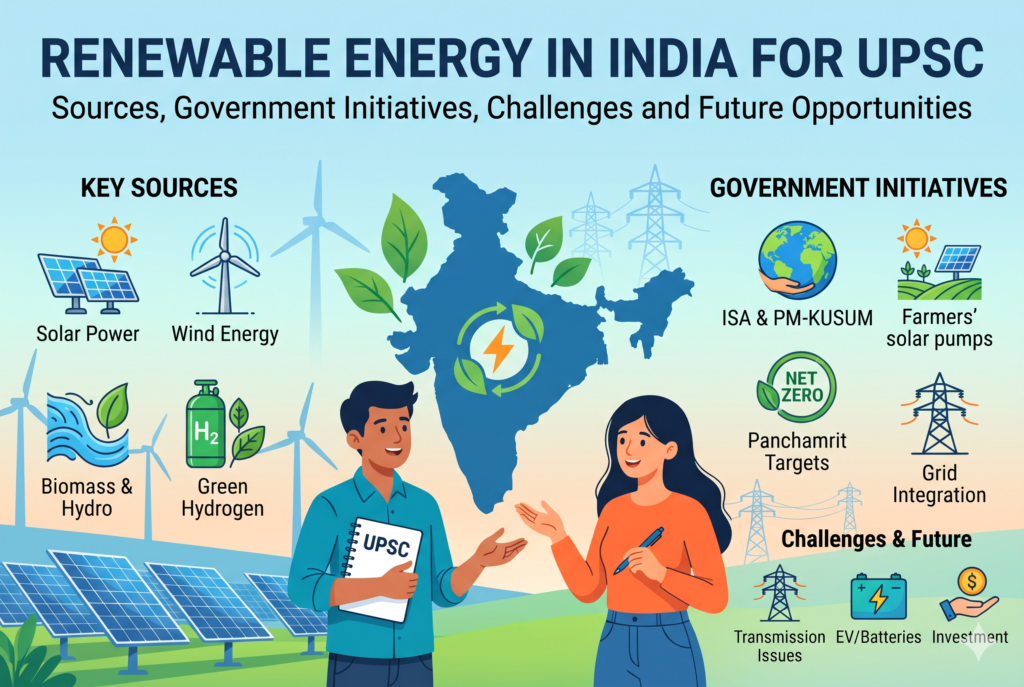
Renewable Energy in India for UPSC is an important topic for Civil Services aspirants preparing for General Studies, particularly Environment, Economy, Science and Technology, and sustainable development. India’s growing energy demand, climate commitments and need for energy security have made renewable energy a significant national priority.
As the country works to balance economic growth with environmental protection, understanding renewable energy sources in India, government policies and implementation challenges becomes essential.
For aspirants preparing through IAS Coaching in Hyderabad at Ignite IAS, this topic provides an opportunity to connect static syllabus concepts with current developments.
What is renewable energy?
Renewable energy refers to energy derived from naturally replenishing sources such as sunlight, wind, flowing water and biomass. Unlike fossil fuels, these sources are replenished through natural processes, although their availability and environmental impacts vary.
Renewable energy can support a more diversified energy system and reduce emissions from electricity generation when deployed responsibly.
Major renewable energy sources in India
1. Solar energy
India has considerable solar-energy potential because of its geographical location and availability of sunlight across many regions.
Solar photovoltaic systems convert sunlight directly into electricity. They can be installed in large solar parks, on residential rooftops, on commercial buildings and in decentralised systems serving rural communities.
For solar energy for UPSC, aspirants should understand:
- Solar photovoltaic technology and its basic working principle.
- Rooftop solar and utility-scale solar projects.
- Solar intermittency and electricity storage requirements.
- Land availability, panel recycling and manufacturing challenges.
2. Wind energy
Wind energy converts the movement of air into electricity through turbines. States such as Tamil Nadu, Gujarat, Karnataka and Maharashtra have significant wind-energy development.
Wind generation depends on local wind patterns, appropriate project locations and transmission infrastructure.
Offshore wind also offers potential, although it requires specialised infrastructure and careful assessment of costs and environmental impacts.
3. Hydropower
Hydropower uses the movement of water to generate electricity. It can support grid flexibility, especially where reservoirs allow generation to respond to changes in demand.
However, large hydropower projects may affect river ecosystems, sediment movement and nearby communities. UPSC answers should therefore consider both energy benefits and environmental concerns.
4. Biomass and bioenergy
Biomass energy uses organic materials such as agricultural residues, animal waste and other suitable biological resources.
Biogas plants, biomass-based power generation and certain biofuel technologies can support waste management and rural livelihoods.
Their sustainability depends on feedstock availability, emissions, land-use effects and responsible production practices.
Why is renewable energy important for India?
Energy security
India imports substantial quantities of fossil fuels. Expanding domestic renewable electricity generation can help diversify energy supply and reduce some exposure to global fuel-price volatility.
Environmental protection
Renewable electricity can lower greenhouse gas emissions compared with conventional fossil-fuel generation, although the full lifecycle impact depends on manufacturing, construction and disposal.
Employment and industrial growth
Renewable energy creates opportunities in project development, engineering, installation, operations, maintenance, manufacturing and research.
Rural development
Decentralised solar systems, agricultural pumps and other suitable technologies can support energy access and productive economic activities in rural areas.
Sustainable development
Renewable energy contributes to sustainable development by supporting cleaner energy access and potentially reducing environmental impacts while meeting growing demand.
Major government initiatives supporting renewable energy
National Solar Mission
The National Solar Mission was launched to promote solar energy development in India and strengthen the country’s solar ecosystem.
PM-KUSUM Scheme
PM-KUSUM supports solarisation in agriculture through measures involving solar pumps and related decentralised solar-energy applications.
It is relevant to questions connecting agriculture, energy access, irrigation and sustainability.
PM Surya Ghar: Muft Bijli Yojana
This initiative promotes rooftop solar installations for eligible households, subject to scheme conditions and implementation guidelines.
National Green Hydrogen Mission
The National Green Hydrogen Mission aims to support the development of green hydrogen production and associated technologies.
Green hydrogen is produced using renewable electricity to power electrolysis and may contribute to decarbonising selected industrial activities.
For the latest programme details, aspirants should consult the Ministry of New and Renewable Energy.
Renewable energy challenges in India
Despite strong potential, several renewable energy challenges in India require policy attention.
Intermittency and energy storage
Solar power is generated when sunlight is available, while wind power varies with weather conditions.
Battery storage, pumped-storage hydropower, flexible generation and improved demand management can help balance the grid.
Transmission infrastructure
Renewable-energy-rich regions may be far from major consumption centres. Grid expansion and modernisation are essential to move electricity reliably.
Land acquisition and ecological concerns
Large projects may require substantial land and affect biodiversity, agricultural activities or local livelihoods.
Project planning should include appropriate environmental assessment and community engagement.
Financing and manufacturing
High initial investment, financing costs, equipment supply chains and technical capacity can influence project development.
Domestic manufacturing, research and stable policy frameworks can improve long-term competitiveness.
India’s energy transition and future opportunities
India’s energy transition involves more than installing renewable generation capacity. It also requires improvements in transmission, distribution, storage, energy efficiency and industrial technologies.
Future opportunities include hybrid solar-wind projects, battery storage, green hydrogen, smart grids, rooftop solar and improved forecasting of renewable generation.
A balanced approach should consider affordability, reliability, environmental protection and economic development together.
UPSC Prelims and Mains preparation
| UPSC stage | Important areas |
|---|---|
| Prelims | Renewable energy types, solar and wind technologies, government schemes, green hydrogen |
| GS Paper III | Energy security, infrastructure, environment, technology and sustainable development |
| Essay | Climate change, sustainable growth, energy independence |
| Interview | Practical energy-policy challenges and development priorities |
Sample UPSC Mains practice question
“Renewable energy is central to India’s energy security and climate strategy. Discuss the major opportunities and challenges associated with its expansion.”
A strong answer should include an introduction, benefits, implementation challenges, government initiatives and a balanced conclusion.
How Ignite IAS supports UPSC preparation
Understanding the environment and economy requires connecting foundational concepts with government policies and current affairs.
Students exploring the Best IAS Coaching in Hyderabad can review Ignite IAS programmes for structured civil services preparation, including General Studies and examination-oriented learning.
Frequently Asked Questions
1. What are the major renewable energy sources in India?
Solar, wind, hydropower and bioenergy are among the major renewable energy sources.
2. Why is renewable energy important for UPSC?
It connects with energy security, climate change, environmental conservation, economic development and government initiatives.
3. What is the National Solar Mission?
It is a government initiative launched to promote solar energy development in India.
4. What are the main renewable energy challenges in India?
Major challenges include intermittency, storage costs, transmission constraints, financing and land-use concerns.
5. How does green hydrogen support energy transition?
Green hydrogen can help reduce fossil-fuel dependence in selected industrial processes when produced using renewable electricity.
6. How should aspirants prepare renewable energy for UPSC Mains?
Study the sources, advantages, government initiatives, limitations and practical policy solutions, supported by relevant examples.